Author name: sinannofficial08@gmail.com

Video Marketing
Uncategorized

Video Marketing Trends: Short-Form Content vs. Long-Form Storytelling

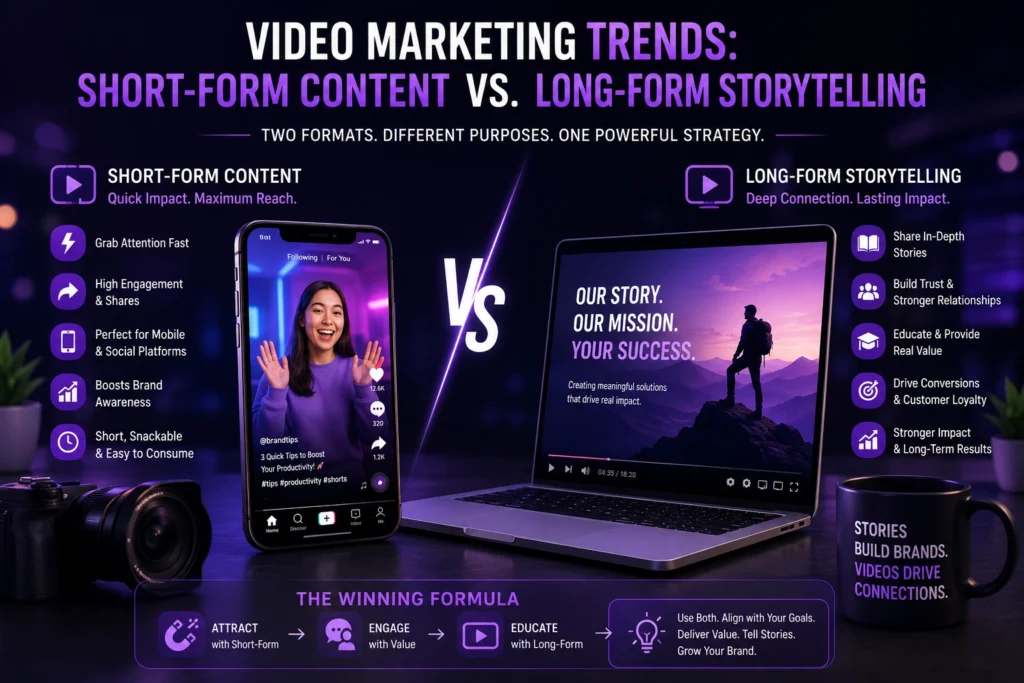
The Evolution of Video Marketing Video marketing has become one of the most influential strategies in the digital landscape. As consumer preferences evolve, businesses increasingly rely on video content to communicate their brand message, educate audiences, and drive conversions. From social media feeds to corporate websites, video has become the primary way brands capture attention and deliver information in an engaging format. As organizations recognize this shift, they continue to invest more resources in video production than ever before. That investment raises an important question: should a business prioritize short-form videos that capture attention quickly, or invest in long-form storytelling that builds deeper relationships over time? Both formats offer real advantages, but the right approach depends on business objectives, target audiences, and overall marketing strategy. Understanding the strengths and limitations of each format is now essential for any marketer building a video strategy. The Rise of Short-Form Video Content Short-form video has grown at a remarkable pace over the past few years. Platforms such as TikTok, Instagram Reels, YouTube Shorts, and Facebook Reels have reshaped how people consume digital content. Because these videos typically run from a few seconds to about a minute, they fit naturally into today’s fast-paced browsing habits. Short-form content also lets brands communicate a key message quickly, without losing the viewer’s attention along the way. Businesses use it to introduce products, show behind-the-scenes moments, feature customer testimonials, and share quick tips. Because these videos are easy to watch, share, and consume across platforms, they tend to generate strong engagement relative to the time they take to produce. The Lasting Power of Long-Form Storytelling Even as short videos dominate social feeds, long-form storytelling continues to play a critical role in content marketing. Longer videos give businesses room to explain complex topics, walk through detailed customer success stories, conduct interviews, and demonstrate products in full. Audiences looking for real depth on a subject consistently favor longer content over a quick clip. Long-form storytelling also builds a stronger emotional connection, since it gives viewers time to understand a brand’s mission, values, and purpose. Rather than leading with a promotional message, a business can build trust through an authentic narrative that actually resonates. As a result, viewers tend to spend more time with brands that invest in telling a real story rather than making a quick pitch. Understanding Audience Behavior in 2026 Consumer behavior keeps shifting alongside new technology. Today’s audiences expect personalized experiences, immediate value, and content that matches their interests. That means marketers need a clear picture of where their audience actually spends time and how long they stay engaged before settling on a video strategy. Younger audiences tend to favor quick, entertaining short-form video for discovery and inspiration. Professionals, researchers, and high-intent buyers, on the other hand, more often turn to long-form educational content before making a purchasing decision. The strongest video strategies are built around these real audience patterns rather than whichever format happens to be trending. Advantages of Short-Form Video Marketing Short-form content offers clear advantages for brands seeking rapid visibility and engagement. Because these videos take less time to watch, audiences are far more likely to watch them all the way through — which tends to lift completion rates, shares, and overall social interaction compared with longer videos. Short-form videos are also generally cheaper and faster to produce than long-form projects. That speed lets businesses respond to trending topics, launch timely promotions, and keep their social profiles active. In turn, brands stay visible and relevant by consistently showing up with fresh, timely content instead of going quiet between big productions. Benefits of Long-Form Storytelling Long-form video creates space to educate, inspire, and persuade in ways a short clip simply can’t. Webinars, documentaries, tutorials, podcasts, case studies, and customer interviews let a business communicate valuable information that would never fit into a one-minute video. Formats like these are also what establish real authority and expertise within an industry. Long-form storytelling builds customer trust through transparency as much as through information. Instead of only advertising a product, a business can walk through its process, introduce the people behind it, and share genuine customer experiences. Audiences tend to place more confidence in brands willing to be that open about who they are and what they offer. Finding the Right Balance Between Both Formats Short-form and long-form content aren’t competitors — they serve different jobs within the same marketing strategy. Short-form video is what attracts attention, builds awareness, and sparks social engagement. Long-form video is what nurtures leads, educates customers, and deepens the relationship over time. The two work best combined. A short social video can introduce a topic and point interested viewers toward a fuller webinar or tutorial hosted on a website or YouTube channel. Structured this way, a single piece of content can maximize reach at the top of the funnel while still supporting customers all the way through their buying journey. Measuring Success Beyond View Counts View count is an easy number to track, but it rarely tells the full story. Engagement rate, average watch time, audience retention, conversion rate, click-through rate, and direct customer feedback all reveal far more about how viewers actually respond to a video. The metric that matters most, though, is whether a video moves the business forward — through lead generation, customer loyalty, or increased sales. Anchoring strategy to outcomes like these, rather than to likes or raw views, is what lets a team refine its approach based on what’s actually working. The Future of Video Marketing New technology keeps reshaping what’s possible in video marketing. Artificial intelligence now assists with editing, subtitle generation, personalized recommendations, and audience analysis, while augmented reality, virtual reality, and interactive video open up entirely new ways to engage a customer. Brands willing to adopt these tools early tend to be better positioned for long-term growth. Even so, the core purpose of video marketing hasn’t changed. A video that educates, entertains, inspires, and builds trust will always perform — regardless of the platform or
Content Marketing
Uncategorized

Content Marketing in 2026: Why Storytelling Still Beats Algorithms

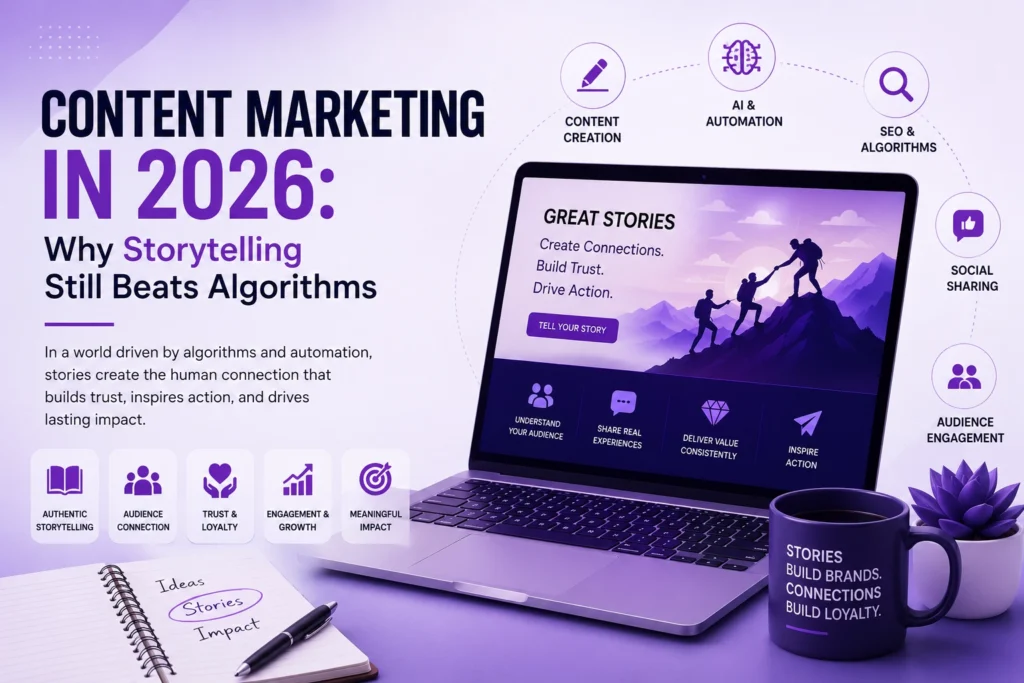
The Human Element in a Digital World Content marketing has evolved dramatically over the past decade. Artificial intelligence, automation, predictive analytics, and advanced search algorithms now shape how brands create, distribute, and optimize content. Yet despite all that technological progress, one timeless principle still defines successful marketing: storytelling. Algorithms determine how content reaches an audience — stories determine whether that audience actually connects with it. Businesses that pair technological innovation with authentic storytelling build far stronger relationships with their customers than those relying on either alone. Consumers in 2026 are also more selective than ever. They encounter thousands of marketing messages a day, which makes capturing genuine attention harder every year. Producing well-optimized content is no longer enough on its own. Brands now need meaningful narratives that inspire trust, evoke real emotion, and earn long-term engagement — which is exactly why storytelling remains the strongest competitive advantage in content marketing today. The Evolution of Content Marketing in the AI Era Content marketing has changed dramatically as artificial intelligence and automation have matured. Marketers once relied almost entirely on manual research, keyword planning, and editorial calendars to produce useful content. AI-powered tools now handle much of that groundwork — streamlining content creation, analyzing audience behavior, and optimizing publishing strategy with a level of precision manual processes couldn’t match. These tools also let businesses pull real insight from enormous volumes of customer data, spotting trending topics and predicting audience preferences far faster than before. But that added efficiency hasn’t replaced the emotional impact of authentic storytelling — it’s simply raised the bar. The brands succeeding today still put human-centered communication at the center of their strategy; they just use AI to support it. Why Storytelling Continues to Outperform Algorithms Algorithms are excellent at spotting patterns, ranking content, and recommending information based on behavior. What they can’t do is replicate human emotion, creativity, or lived experience. Stories create connection precisely because they reflect real challenges, aspirations, and achievements — the things audiences naturally recognize and remember. Storytelling also turns an ordinary marketing message into something memorable. Instead of listing product features, a brand can communicate its purpose, values, and customer impact through a real narrative. That’s what builds an emotional bond an algorithm-optimized post never will — audiences respond to companies that share authentic stories, not just companies that rank well. Building Trust Through Authentic Brand Narratives Trust has become one of the most valuable assets in modern marketing. Consumers increasingly favor brands that show transparency, honesty, and consistency in how they communicate, which is exactly the role storytelling plays: establishing credibility and strengthening the relationship over time. An authentic brand story also humanizes a business by revealing its mission, its values, and its actual commitment to solving customer problems. A company stops looking like a faceless organization and starts looking like a partner that understands what its customers need. That shift is often what gives people the confidence to buy — and to recommend the brand to someone else. Balancing Artificial Intelligence with Human Creativity Artificial intelligence has become an essential tool for marketers, assisting with keyword research, audience analysis, content optimization, and performance measurement. Used well, it lets a team produce higher-quality content while working far more efficiently. Used carelessly, it becomes a shortcut that flattens everything it touches — which is why AI works best as a complement to creativity, not a replacement for it. Human writers still bring something AI can’t fully reproduce: empathy, cultural nuance, and emotional intelligence. They understand humor, pacing, and personal experience in ways that genuinely resonate with an audience. The organizations getting the best results are the ones combining AI-driven efficiency with real human creativity, rather than picking one over the other. Creating Customer-Centered Content That Inspires Action Effective content marketing starts with understanding the audience, not promoting the product. When a business identifies real customer challenges, answers the questions that actually matter, and offers meaningful solutions, readers start treating that brand as a trusted source of information rather than just another advertiser. Storytelling is what makes those solutions land. Rather than explaining a benefit in the abstract, a brand can show a tangible outcome through a real customer’s success story. That’s the moment a reader becomes emotionally invested — and emotional investment is what turns a passive reader into an engaged customer. The Growing Importance of Emotional Engagement Algorithms influence visibility, but emotions influence decisions. Consumers consistently remember emotional experiences far longer than they remember facts, which means brands that create genuinely emotional stories see real gains in customer retention and loyalty. Emotional storytelling also drives sharing. People pass along content that made them feel something to friends, family, and colleagues, expanding a brand’s organic reach in a way no algorithm can force. Instead of depending entirely on platform distribution, a compelling story starts conversations that carry well beyond the original post. Measuring Success Beyond Search Rankings Search rankings are still a useful signal, but they don’t tell the whole story. Metrics like time on page, repeat visits, newsletter subscriptions, direct customer feedback, and conversion rate reveal far more about whether content is actually working. Storytelling also builds brand equity that doesn’t always show up in short-term data. A story a customer remembers can influence a purchasing decision weeks or even months later. That’s why the smartest organizations balance quantitative performance metrics with a real read on customer trust and loyalty — not just this week’s traffic numbers. Preparing for the Future of Content Marketing Content marketing will keep evolving as AI, voice search, augmented reality, and personalized experiences grow more sophisticated. None of that will make authentic communication less important — if anything, it opens new channels for brands to tell richer, more engaging stories across more touchpoints than ever before. The businesses that adapt well won’t be the ones that pick a side between AI and storytelling. They’ll be the ones that integrate both — using automation to work faster and smarter, while keeping a real, human story at the

AI in Digital Marketing
Uncategorized

The Rise of AI in Digital Marketing: How Automation Is Reshaping Customer Engagement

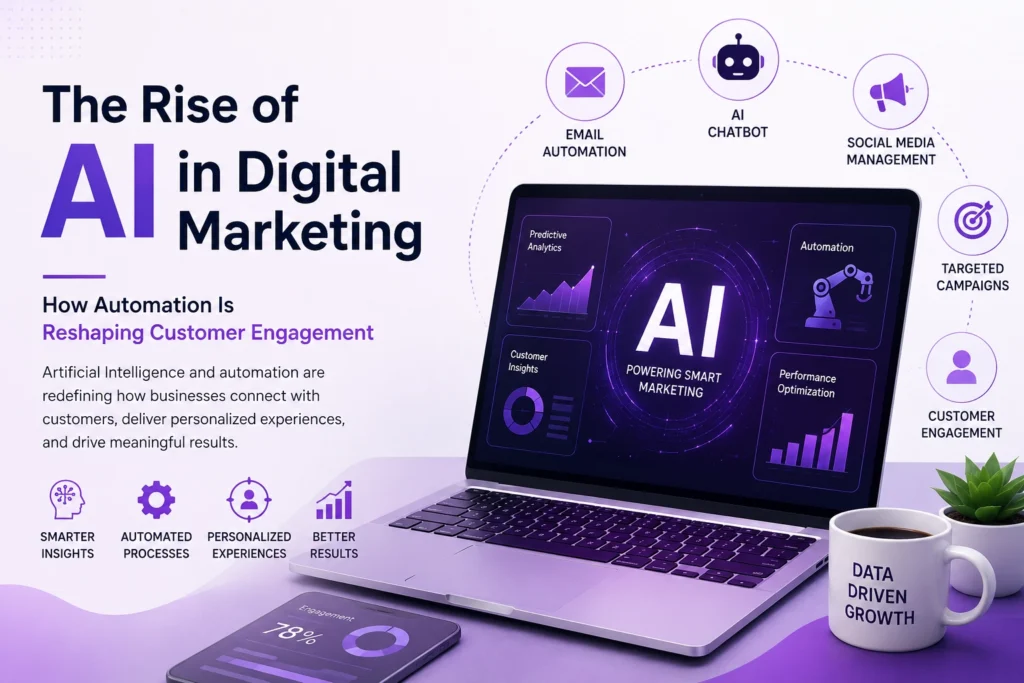
AI Takes Center Stage in Digital Marketing Artificial intelligence has become one of the most transformative forces in the modern business landscape, and few fields have embraced it as quickly or as effectively as digital marketing. As consumer expectations keep rising, businesses now have to deliver personalized, timely, and meaningful experiences across a growing number of digital channels. AI-powered automation has emerged as the tool making that possible, improving operational efficiency without sacrificing the personal touch customers expect. Importantly, none of this automation is designed to replace human creativity. Instead, AI in Digital Marketing is designed to extend it, giving marketers the ability to analyze large datasets, predict customer behavior, and execute campaigns with a level of precision that manual work never allowed. As a result, teams can spend more time on innovation, strategic planning, and relationship building while AI absorbs the repetitive, data-heavy work underneath it. The Digital Marketing Revolution: From Traditional Strategies to Intelligent Systems Digital marketing has changed significantly over the past two decades, and AI has accelerated that shift dramatically. Businesses once relied on broad advertising campaigns, manual audience segmentation, and generalized messaging to reach potential customers. Those methods produced results, but they lacked real personalization and demanded enormous manual effort to run. Today, AI-powered platforms in AI in Digital Marketing analyze huge volumes of customer data in real time, letting marketers spot patterns, understand customer preferences, and optimize campaigns with a level of accuracy that simply wasn’t possible before. Businesses now base decisions on predictive insights instead of assumptions—a shift that keeps them competitive in a marketplace that moves faster every year. Why Automation Has Become the Backbone of Modern Marketing AI has changed how marketing teams operate day to day. Rather than manually managing email campaigns, scheduling social posts, or monitoring every customer interaction by hand, businesses now automate those routine tasks through intelligent marketing platforms — saving time while keeping communication with their audience consistent. Automation also cuts down on repetitive work and reduces human error. AI systems track campaign performance continuously, flag opportunities for improvement, and make adjustments without the delay a manual review would require. That shift frees marketing professionals to spend more of their time on strategy, creative storytelling, and the customer relationships that actually drive loyalty. Personalization: Creating Meaningful Customer Experiences Modern consumers expect a brand to understand their interests, and generic advertising no longer captures attention the way personalized experiences do. AI gives businesses the ability to analyze browsing behavior, purchase history, demographic data, and engagement patterns, then use that analysis to deliver content that’s actually relevant to the person seeing it. That relevance builds trust. A customer who sees recommendations aligned with their real needs, instead of another irrelevant promotion, engages more, stays more satisfied, and converts more often. Personalized communication has become one of the clearest markers separating a strong digital marketing strategy from a mediocre one. Predictive Analytics: Turning Data into Strategic Decisions Organizations generate enormous amounts of customer data every day, but collecting it doesn’t guarantee anything on its own — it has to be interpreted well to be useful. AI-powered predictive analytics solves that problem by identifying trends, forecasting future behavior, and recommending the next strategic move. Predictive analytics also lets marketers anticipate customer needs before those needs become obvious. A business can predict purchase intent, flag customers at risk of churning, and recommend products based on past interactions — responding proactively instead of reactively, which is exactly what drives stronger retention and marketing performance. AI-Powered Customer Support and Conversational Tools Customer service now plays a major role in purchasing decisions, and AI-powered chatbots give businesses a way to provide immediate support throughout the customer journey. Unlike the rigid automated responses of a few years ago, today’s chatbots understand natural language and hold context-aware conversations that feel much closer to talking with a person. These tools also work around the clock, so customers get help regardless of time zone or business hours. They answer common questions, recommend products, assist with purchases, and resolve routine issues on their own — which improves customer satisfaction while freeing human support teams to focus on the complex cases that actually need their expertise. Smarter Content Creation Through Artificial Intelligence Content is still one of the most valuable assets in digital marketing, but producing it consistently takes real time and effort. AI eases that load by helping marketers identify trending topics, sharpen headlines, understand audience preferences, and time publishing for maximum reach. AI-powered optimization tools also evaluate readability, keyword relevance, and likely engagement before a piece ever goes live, which improves content quality and visibility at the same time. Human creativity still drives the storytelling itself — AI simply makes that creativity more efficient and better informed. Building Seamless Customer Journeys Across Multiple Channels Customers interact with brands through websites, mobile apps, email, social media, and online marketplaces, which makes consistency across those channels harder to maintain than ever. AI helps by unifying customer data from every touchpoint into one coherent, personalized experience throughout the journey. That consistency shows up in small but meaningful ways — a customer who browses a product on a website might later see a personalized email or social ad featuring something similar. Moments like that create a cohesive experience that keeps engagement high and nudges purchasing decisions forward. Ethical Challenges and Responsible AI Implementation AI brings real advantages, but it also raises ethical questions organizations can’t ignore. Data privacy, transparency, and responsible handling of customer information have become central concerns for any business operating at scale in the digital age, and compliance with relevant regulations is no longer optional. Just as important, businesses shouldn’t lean on automated decision-making alone. Human oversight is still essential for keeping campaigns fair, creative, and emotionally intelligent. The organizations getting this right combine AI’s capabilities with experienced people who understand both customer expectations and the ethical responsibility that comes with using their data. The Future of Customer Engagement in an AI-Driven World Artificial intelligence keeps evolving at

Scroll to Top